
Art therapies implicitly carry a different way of conceiving health and illness, as they stem from a holistic, more positive and integral conception of the human being, in line with the definition of the World Health Organization, in which illness is not so much the absence of health but the difficulty or inability to access one’s own potential within the specific context in which the person lives, associated with a deprivation of physical, mental, and social well-being. In many countries around the world, such as the United States and the United Kingdom, art therapies already have significant development as scientific and professional disciplines, supported by their corresponding university training.
Schools need to change to respond to the challenges posed by society. Current pedagogy confirms the need to design multidimensional educational models that contribute to the parallel development of all human potential. An education that simultaneously addresses affective, procedural, and interpersonal dimensions, yielding qualitatively superior results. Helping to develop a self-actualized person, as Maslow said: a healthy person, should be the primary objective of the school.
Education should integrate art therapies, understood for the development and emotional regulation, which is fundamental to the human being, as support and aid for mental health.
Creativity, expression, and art are valid resources for prevention and therapeutic intervention both inside and outside of school.
Objectives of Art Therapies within the school:
Art therapies have a series of objectives when put into practice within the school environment:
- Provide an active space for listening and dialogue, free of judgment
- Reduce anxiety and help children feel more comfortable in the school environment
- Work on basic cognitive processes such as memory and attention
- Help the child organize their descriptions and narratives
- Help children express themselves much better, sometimes, than if they did so verbally
- Express feelings difficult to talk about
- Self-esteem and confidence
- Develop healthy adaptive skills
- Identify feelings and blocks to emotional expression and growth
- Offer new avenues of communication
- Enhance creative capacity
- Respect and promote free expression
- Facilitate self-knowledge and reflection
- Strengthen and reaffirm identity and self-esteem
Art therapy as a means for personal growth
An important aspect to consider within the educational field is the contribution of art therapy to personal growth and personality development.
Educating means contributing to personal growth and personality development. According to Romero (2002), freed from the constraints of other eras, personality psychology increasingly attends to the emotional dimension of the human being, and to processes related to the self, which seem to play a crucial role in personality integration and behavior regulation. Taking into account, above all, that art therapy is a discipline that enables human assistance using artistic means, images, the creative process, and the person’s responses to those created products. Through the creative process, reflection occurs on the individual’s development, personal conflicts, and interests.
I want the possibilities of art therapy as an element that promotes the comprehensive development of the student to be taken into account, to encourage its use in schools. Its practice will facilitate the work of teachers, the school climate, and above all, the student’s development.
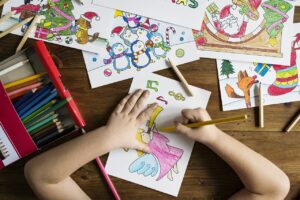
Society in general will benefit, as it is the one that ultimately benefits from the type of people who develop within it, but above all because the school and its teachers will find in art therapy a tool to create that humanist school where culture is recreated and healthy, conscious, creative, free individuals are formed. And therefore, a place to live and coexist in that way.
Above all, students will benefit, as if the school adopts the practice of art therapy as a regular activity, they will have other means to develop, adjusted to their interests and needs. The integration of art therapy into the educational system must be the task of the 19th century for art therapists.
Art therapies have a very broad dimension regarding the influence they can have on human beings from all the areas they cover: cultural, historical, aesthetic, educational, intellectual, creative, anthropological, and many more connections could be sought, but my intention is to focus on their capacity to communicate, express, and therefore “move” or “evoke emotion.” Art therapies are the language of emotions, “art is the emotional expression of personality.”
The school as the central axis of art therapy
The school should have its central focus on play, creation, and art so that students naturally learn and relate to others. That is why art therapies are a form of intervention that covers these three mentioned elements, serving for the individual’s personal and social development.
The development of emotional competencies within the school must be the main objective to address through art therapies, achieving an integrated identity for the child: body, affection, mind.
The development of emotional competencies is conceived as a continuous and permanent educational process, which aims to enhance the development of emotional competencies as the essential element of people’s comprehensive development, with the aim of enabling them for life. All of this aims to increase personal and social well-being. It is therefore an education for life, which implies a continuous and permanent process that must be present throughout the entire academic curriculum and the lifelong learning of every individual.
Through the learning of emotional competencies, students not only expand their emotional vocabulary but also learn to employ coping strategies in emotionally difficult situations, achieving emotional self-control, so that they adequately manage conflicting emotions and impulses (Vallés, 2000).
The objectives of implementing emotional competencies through art therapies:
– Detect cases of poor performance in the emotional area.
– Know what emotions are and recognize them in others.
– Classify them: feelings, moods.
– Modulate and manage emotionality.
– Develop tolerance to daily frustrations.
– Prevent drug use and other risky behaviors.
– Develop resilience.
– Adopt a positive attitude towards life.
– Prevent interpersonal conflicts.
– Improve the quality of school life.
Helping children develop emotional skills will positively affect their age and long-term well-being. Efforts should be made to educate children emotionally in schools in order to enhance their comprehensive development, and this can be possible through the integration of art therapies into the educational system.