
This article is a synthesis of the Master’s Final Project by Juliana Monteiro Lazaro, a student of the Master’s in Intervention in Learning Difficulties, which aims to raise awareness and provide guidance to professionals working in primary education, specifically in the learning of children with Down Syndrome, emphasizing that all activities should be designed so that all children can perform them, regardless of special needs, social, cultural, interest, or learning style differences.
If you want to read the full Master’s Final Project, you can do so here.
Working on emotional education
In order to work on emotional education and thus help students improve their autonomy and self-image, teachers must use resources that stimulate creativity, socialization, and decision-making. The application of playful strategies, based on the content and theme of the classes, allows for achieving an educational didactic model that favors the performance and evolution in the learning of children with Down Syndrome or other special needs, as well as that of their peers.
Childhood learning through play
Play is a path that leads us towards thinking and, therefore, promotes what should be the most important aspect in education: making children learn to think. Furthermore, play allows for the development of the child’s different academic aptitudes, as well as social and emotional skills, as these are factors linked to cognitive development.
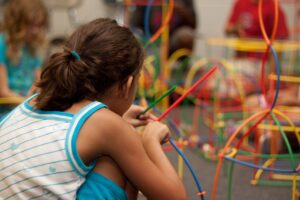
Emotions condition attitude in such a way that if an activity is related to something positive, it generates a series of connections that, in the long term, create an identity. Similarly, social competence and interaction with others allow for generating essential bonds for comprehensive development. Therefore, it is important that in the educational field, the use of games or playful strategies, as well as cooperative learning, is encouraged, not only for social interaction but also as an effective learning method that addresses diversity.
On the one hand, primary school teachers should use games or playful strategies adapted to the needs of each group, in which curriculum content can be included, where students, in addition to being immersed in a process of meaningful and cooperative learning, enhance the learning of all students.
On the other hand, teachers must also ensure that the transmission of concepts such as diversity, respect for oneself and others, and the fact that difference does not separate us, but rather enriches and completes us; is done in a playful way.
The introduction of playful strategies in school
The possible limits and scope of introducing playful strategies in the school environment lie in the awareness, on the part of all professionals involved in the education of special needs children, of the possibility of fostering learning through a set of playful strategies in the daily classroom routine. A practice from which the rest of the group would also benefit.
However, the idea is not to gamify classes. It is simply to suggest a powerful tool like play to change the outdated teaching method of traditional education, based on books and teacher-centeredness, towards a more experiential teaching where the use of new technologies, the artistic world of music, dance, theater, painting, among many others, can also be explored.
As well as extracurricular excursions or classes outside the classroom environment, thus promoting direct contact with the studied environment in its context. In this way, students acquire the necessary tools to achieve comprehensive development, from a playful and motivating approach, being an effective resource to enhance the learning of all children, thanks to the emotion, creativity, and inclusion it provides.