
This text is a synthesis of the Master’s Final Project carried out by Ana Clemente Cortés, a student of ISEP’s Master’s degrees in Learning Difficulties, Therapeutic Psychopedagogy, and Special Education on ‘The family as a protective factor in ADHD evolution’. You can consult the full text here.
What is Attention Deficit Hyperactivity Disorder (ADHD)?
Attention Deficit Hyperactivity Disorder (ADHD) is a persistent pattern of inattention and/or hyperactivity-impulsivity of a chronic nature. ADHD symptoms have negative repercussions on cognitive, personal, and social development, posing a barrier to school learning and the subject’s general adaptation to their environment (Miranda and Soriano, 2010).
The main objective of this text is to confirm the relevant role of the family system in the satisfactory evolution of ADHD symptoms, through its participation in psychoeducational programs that include information about ADHD, behavior modification techniques, self-regulation, and social skills, mainly.
How does the family context influence the evolution of ADHD symptoms?
Attention Deficit/Hyperactivity Disorder is the result of the interaction of environmental risk factors and the susceptibility of multiple genes (Faraone, Perlis, Doyle, Smoller, Holmgren, et al. 2005). Thus, the psychosocial environment is considered a modulating factor that influences how the symptoms of the disorder (inattention, impulsivity, and hyperactivity) are understood and managed by the family, school, and society (Miranda, Grau, Taberner and Roselló, 2007).
Research on ADHD
Numerous studies point to the relevant influence of the family context on the course of ADHD (Miranda, García and Presentación, 2002). Parents of children with Attention Deficit Hyperactivity Disorder show high levels of stress, marital disagreements, and a more limited social life (loss of reinforcers) (Roselló, García, Tárraga and Mulas, 2003).
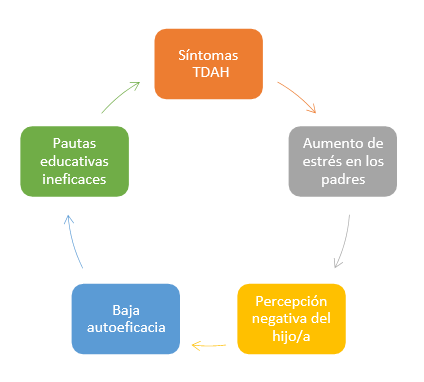
ADHD generates a negative impact on the family system, mainly influencing a negative perception of parents towards their children, an increase in stress levels, and the use of authoritarian or permissive parenting styles, which reinforce maladaptive behaviors and increase conflict in family relationships. Furthermore, parents perceive themselves as unable to cope with the difficulties that ADHD generates in family life. Therefore, it is confirmed, on the one hand, that ADHD generates a negative impact on the family system, but at the same time, parents’ feelings and attitudes can act as a risk factor in the evolution of symptoms, enhancing their severity and increasing the likelihood of behavioral disorders.
Effects of family-focused intervention on ADHD evolution
Intervention aimed at the child with ADHD, their family, and the school (multicontextual or multicomponent) generates a beneficial impact for the entire family. Parents’ view of their child is more positive, and as a consequence, relationships in the family system are strengthened.
Benefits of family-focused intervention
Family-focused intervention leads to a reduction in parental stress levels, which in turn allows them to use more effective parenting guidelines that have a beneficial effect on the behavior of the child with ADHD. Thus, it is demonstrated that parents and children influence each other.
Miranda et al., (2008) conclude that it is necessary for parent counseling programs to take into account the impact that ADHD generates in the family system and to instruct them in stress management strategies, specifically addressing their emotions, their negative perceptions or attributions about their child, and how they can build a democratic parenting style based on effective communication. In addition, behavior modification techniques are also taught and put into practice, including when and how to use them appropriately. This type of intervention helps parents increase their self-confidence and confidence in their children.
Conclusions
Through the review carried out, it can be confirmed that the family has a clear modulating effect on the evolution of Attention Deficit Hyperactivity Disorder. Furthermore, different studies have concluded that a child with ADHD has a negative impact on their family, mainly affecting relationships between members. These effects, and taking into account that in a family system all members interact and influence each other, lead to the conclusion that ADHD intervention must consider psychosocial factors, with the family being the most studied context. From this, multicomponent interventions are proposed, which include the child, family, and school, in order to generalize behaviors in the natural environment and coordinate to work in the same direction.
It is confirmed that these treatments have a positive effect on the family, reducing stress levels, parents’ feelings and attitudes, and improving children’s behavior. However, this review did not find studies that emphasize how parents using educational guidelines based on respect, affection, and firmness, effective communication, and knowing how to control their emotions influence the evolution of ADHD symptoms.
It is very important to continue working along this line, taking into account the limitations of other studies conducted (sample size, ADHD subtypes, age, participation of both parents in the study, etc.). Furthermore, it would be crucial to research the family as a protective factor in the course of Attention Deficit/Hyperactivity Disorder. On the other hand, few studies have been conducted on attachment style and ADHD; the results obtained to date relate insecure attachment to Attention Deficit/Hyperactivity Disorder. The objective of future studies would be to observe how attachment bonding models may be involved in this disorder and how they affect treatment response. From here, the research line of Santurde and Del Barrio (2013) on how to intervene in promoting attachment could be continued.
Remember that you can download Ana Clemente Cortés’s Master’s Final Project in full here. If you are interested in obtaining more information about ISEP’s Master’s in Intervention in Learning Difficulties, do not hesitate to request it!