
UNESCO launched an initiative called “your vision for education in 2050”, where people from all over the world can share a visual expression of their expectations, fears, and ideas about the future of education. One characteristic prevails in all images: the omnipresence of technology as a tool for knowledge transmission and mediation of education and learning processes.
The world envisioned is one where educational innovation and digital competencies are a primary part of the educational curriculum and will transform educational dynamics in unthinkable ways.
Chalk, blackboards, and notebooks have been replaced by computers, technology, and digital environments, standing strong, even more so, after the pandemic.
In this article, we want to reflect with you on the importance of educational innovation and education in and through digital competencies in today’s school.
What is Educational Innovation?
Innovation is change, transformation, and the introduction of something new or unknown to create new experiences. In the case of education, it would involve changes to enhance, transform, or modify the teaching-learning process and the educational experience.
Innovation is the process of creating new knowledge, products, and new processes. Educational innovation is the adoption in the educational environment of something that already exists outside of it but would transform it.
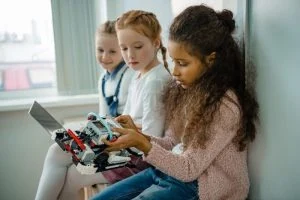
In educational innovation, there are four fundamental pillars: people, knowledge, processes, and technology. This futuristic approach to education not only consists of introducing technology as a mediator of the pedagogical process but goes far beyond this understanding.
Clearly, in educational innovation, we see trends and developments in gamification, active and collective learning, flipped learning, artificial and augmented intelligence, and project-based learning, to name a few of the transformations.
Undoubtedly, given a changing educational model, teachers must commit to constant learning and see technology as a collaborator to increase the efficiency, effectiveness, and efficacy of learning processes. As well as asking themselves how they can begin to implement innovation in their classrooms.
Educational innovation is a natural evolution of teaching, not only driven by technology but also by the new human, more active and critical in their learning processes; and whose participation causes a positive impact on this pedagogical orientation.
Educational innovation also proposes continuous improvement and constant transformation so that schools do not fall behind advancements but keep pace with them. An innovative education demands lifelong training and improvement from professionals, as well as a permanent review of their processes and content.
Digital Competencies in School
In a hyperconnected world, digital competencies are not mere artifice but an increasingly priority demand in societies, business organizations, and academic institutions.
The ability to manage, analyze, and apply technology to improve our lives is a demand of the current world. But beyond this technological pragmatism, what is also expected is reflection and the generation of knowledge that supports these innovations and competencies and shapes the men and women of the future.
Among the digital competencies in school, training focused on the following should be promoted:
- Information and technology literacy: Initially, teachers and students must understand the importance, development, and current state of technology and promote technological literacy among colleagues, students, and still-relegated parents. Despite being student-centered, the school should not neglect this fundamental aspect for life in society. Also consider curricular modification to grant relevant spaces for STEAM content.
- Communication and collaboration: Promote communication of technology-mediated processes and collaboration in virtual spaces. As well as the development of their own virtual processes, methods, and tools to enrich teaching.
- Content creation: Generate content capable of overcoming spatio-temporal barriers. That is, generate content that students and teachers can consume in a virtual sphere with equally virtual tools, devices, and supports.
- Security: Understand the risks, exposures, and ambivalences of the digital world and train students, parents, and teachers in internet security and the ways this interaction space should be managed.
The Teacher of the Future
Considering that educational innovation is the protagonist of this global transformation of education generated from and through virtual environments, it is important for teachers to train and educate themselves in the understanding, analysis, study, and application of these technology tools in education. Continuous training and technology will be a permanent demand, and that is why at ISEP University, educational innovation is transversal to all academic programs in the Education area.