
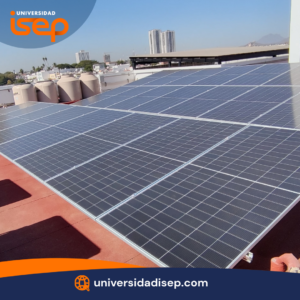
At ISEP University, we don’t just educate to transform lives; we also seek to inspire changes that transform the planet. With this objective in mind, we have installed 70 solar panels in our administrative offices, achieving a total capacity of 585 kilowatts (kW). This project not only reflects our responsibility as an educational institution committed to the environment, but also positions ISEP as a Socially Responsible organization, willing to lead the change towards a more sustainable future.
The adoption of solar energy is not an isolated act; it is part of a comprehensive vision that seeks to reduce our environmental footprint, optimize resources, and educate by example. Join us to explore how this initiative marks a before and after for our institution, the educational community, and the environment in which we live.
How did we determine the impact of this project?
The implementation of the solar system was not random. Before deciding on this installed capacity, we conducted a detailed analysis of our energy consumption. This included:
- Annual consumption record: We added up the energy used during the previous year in our administrative offices.
-
Monthly average calculation: We divided this figure by the 12 months of the year to obtain a reliable monthly average, which allowed us to understand our real energy needs.
-
Definition of optimal capacity: Based on this analysis, we installed 70 solar panels with a total capacity of 585 kW, enough to cover a large part of our usual energy consumption.
The system’s efficiency is evident. In just 10 days of operation, the energy generated has resulted in savings equivalent to 87 trees planted. If we extrapolate this impact over a full year, we discover that it is equivalent to 3,000 trees planted.
What do 3,000 trees mean for the environment?
To dimension the environmental impact of this figure, it is useful to translate it into more tangible terms. Let’s consider a common density in reforestation projects: 1,000 trees per hectare, which is equivalent to an average separation of 3 x 3 meters between each tree.
Based on this density, 3,000 trees are equivalent to:
- 3 hectares of completely regenerated forest.
-
3 professional soccer fields, given that a standard field measures approximately 1 hectare.
The environmental impact in figures
- Carbon dioxide (CO₂) absorption: These 3,000 trees could capture around 45 tons of CO₂ per year, helping to mitigate climate change.
-
Oxygen production: The amount of oxygen generated by these trees would be enough to supply 6,000 people for an entire year.
-
Biodiversity improvement: Forested areas not only capture CO₂, they also provide essential habitats for countless species of flora and fauna.
Imagine a space equivalent to three soccer fields full of trees, providing shade, clean air, and life to the planet. This is the positive environmental impact we are achieving thanks to the implementation of solar panels.
Commitment to sustainability: More than numbers
Adopting solar energy not only generates tangible environmental benefits but also reinforces fundamental values in our educational community and society. Let’s look at some of the most prominent aspects:
1. Direct reduction of CO₂ emissions
The electricity generated by solar panels comes from a clean and renewable source, meaning it does not depend on fossil fuels. This allows us to reduce our carbon footprint and actively contribute to cleaner, healthier air for everyone.
2. Education by example
Sustainability is not just a concept we teach in classrooms; it is a daily practice we model for our students. The installation of these solar panels tangibly shows them how strategic decisions can generate positive change in the environment.
3. Environmental awareness in action
The equivalent of 3,000 trees planted is more than a figure; it is a reminder of the power our actions have when taken with responsibility and purpose. Every member of our university community can feel part of this change and be an ambassador for sustainability.
Our general director, Marc Gaja, expressed the importance of this project as a milestone in our journey towards sustainability:
“At ISEP University, we are building a legacy beyond virtual classrooms. This solar energy project is a declaration of principles: we want to lead by example, demonstrating that organizations can be successful while protecting the environment. Each installed panel is a step towards a cleaner future, and each equivalent tree represents our commitment to future generations. We are convinced that education must be a driving force for change, not only to transform lives but also to transform the planet.”
These words reflect our institution’s vision: to be leaders not only in education but also in social and environmental responsibility.

Beyond the panels: A comprehensive sustainability strategy
The installation of 70 solar panels is just the beginning. This project is part of a broader strategy that seeks to integrate sustainable practices into all our operations. Some of our future goals include:
- Increase energy autonomy: We plan to continue expanding the capacity for renewable energy generation in our facilities to further reduce dependence on external sources.
- Incorporate sustainability into the academic curriculum: Through workshops, courses, and case studies, we seek to inspire our students to be agents of change in their communities.
Transforming the future, one panel at a time
At ISEP University, we are convinced that change begins with small actions that, when combined, generate an enormous impact. The installation of these solar panels represents a firm step towards sustainability, but it is also a reminder that we can all contribute to caring for the planet from our sphere of influence.
Through this project, we have achieved: