
Art can be used as a social inclusion strategy. In this article, we present an initial approach to this topic of utmost importance for alternative education from an integrative and channeling perspective in the face of inappropriate social behaviors in the classroom, the latter being a reason for dropout and low academic performance.
Education and Family in Social Behavior
Every Educational System seeks to guarantee the social character developed in the academic field, proposing as an objective to form individuals capable of recognizing, accepting, and loving themselves as they are, supportive citizens who feel, support each other, and in turn generate concern for others in the face of their needs, covering all stages of human development and including the community and family in this process; thus seeking to unify criteria that consolidate cooperative work within each learning environment, especially in the early years of life, which allows the learner a balanced development both intellectually and emotionally.
The first years of schooling are of great relevance, as it is where social adaptation processes are developed and the observance of group-consensual norms is learned, thus forming in students skills such as building agreements and respecting social guidelines, which, when fulfilled, generate healthy interaction among all the key players in the teaching-learning process who are part of the school.
However, the school environment not only directly influences the comprehensive formation of human beings but also the family, which plays a fundamental role in the development of the individual’s social skills, notably conflict resolution, which is essential for coexistence in a given environment.
For this reason, the active participation of family and school is essential for balance in the student’s comprehensive education; however, if effective communication between school and family fails, a risk situation could arise where inappropriate social behaviors will then become the protagonists of students’ attitudes and habits, generating in them a lack of belief and low self-worth, which significantly diminishes the primary objective of education.
When homes are characterized by dysfunctionality, regularly due to the absence of a parent, non-compliance with parental roles, lack of rules, and inadequate communication between parents and children, it is imperative that the social environment presents a high index of deterioration caused by a high load of violence, aggression, insecurity, devaluation of life and work, seeking to categorize the perfect excuse to break the family-school relationship.
It could be said that in this way, Bandura and Roger’s behavioral theory is reaffirmed, specifically the relationship of the social environment as an initial influence in the ideological creation of the real self and the ideal self in the face of social development and evolution, which refers to following the example given by significant adults regarding the handling of certain everyday life episodes. Based on this, it can be inferred that this model induces inappropriate behaviors in the learner within the classroom.
Given this significant situation in Latin America, educational institutions seek to ensure that students, through socialization, are in contact with a learning environment where coexistence norms and value-based work are developed, to satisfactorily improve their performance within the community, while also achieving the gradual detachment from social risk that develops in their environment and significantly affects academic performance.
However, within the classroom, it is evident that some learners develop inappropriate social behaviors by not following the consensual norms that govern school dynamics, limiting the teaching-learning process, which results in rejection towards the student exhibiting this type of behavior, while due to lack of knowledge, the behavior is reinforced and it is possible that it is linked to the extrinsic growth of an environmental learning difficulty.
Art as a Social Inclusion Strategy
Starting from this reality, it is necessary to promote significant and innovative changes as an educational alternative. One of them is the use of arts as a teaching-learning strategy to foster and contemplate bodily and linguistic development. It is a perfect tool to channel inappropriate social behaviors while developing social skills as well as personal aptitudes, which helps social integration by allowing them to act and actively involve themselves in the creation, relationship, and reflection on their work and that of others, without reducing opportunities to merely inquire into creative processes.
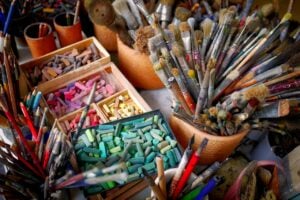
The truth is that arts are forms of representation that use the body, voice, space, and time to express and communicate through feelings, ideas, or experiences that specifically contribute to the development of socialization capacities, creating habits of organization and mutual cooperation, which confront situations of continuous breach of coexistence norms within the institution and the common learning environment, as well as reducing the use of coprolalic vocabulary and the recording of actions that show aggression, which allows for the fluidity of optimal academic performance within the classroom.
For this reason, arts, viewed from a perspective for social transformation, can be a child and youth intervention technique, seeking the integration of the educational community as a whole, raising awareness of the possibility of change and academic improvement through strategies that immerse scenography, creative writing, painting, theater, and music, in order to strengthen values such as honesty, camaraderie, respect, communication, tolerance, empathy, among others that foster effective and assertive coexistence inside and outside the school, making active parental participation indispensable in this process.
Considering the usefulness of these as a starting point to break down pre-existing ideological barriers in regular classroom teachers regarding resistance to curricular adaptations, which seek to promote significant changes from behavioral aspects to the ease of knowledge acquisition in learners often categorized as problematic.
Therefore, it is suggested that those in charge of educational institutions promote awareness spaces where learning circles for updating innovative artistic strategies that can be applied in the classroom are scheduled. Likewise, it is fundamental that the teacher achieves:
- Understand the real cause of what generates inappropriate social behaviors in learners.
- Focus on a clear short-term objective to achieve with schoolchildren.
- Recognize the artistic potential of children, whether painting, singing, drama, among others.
- Build desired activities together with students, seeking global participation without exclusion.
- Project activities within the classroom and community planning, to break schemes and conceptions about working with the arts and its value in favor of social coexistence without exclusion.
If you are interested in delving deeper into the topic, you can review the following bibliographic sources:
- Bellón M. (2020). Innovation Project: Art Therapy in Students at Risk of Social Exclusion. Comillas Repository of the Pontifical University. Retrieved on September 1, 2021, from https://repositorio.comillas.edu/xmlui/handle/11531/43043
- Naranjo, L (2020). Art Therapy to Intervene in Childhood Behavior Problems. An Approach to Research from 2000 to 2020. UNIMINUTO Digital Collections. Colombia 23-11-2020. Retrieved on September 1, 2021, from https://repository.uniminuto.edu/handle/10656/11934