
The Evolution of Communication Processes in Education
Communication processes have evolved from articulated language to the opening of the information and communication era, which generated modifications in various contexts, including education, as the public internet network brought with it faster information search processes, mechanisms, and procedures. However, today the goal is to go further through “Knowledge Management” where reflections on information are generated and where the denationalized exchange of knowledge is fulfilled (Guanipa, 2019).
It is worth noting that within this framework of perennial transformation, Information and Communication Technologies
(ICT) were not initially created for educational development; but for economic development. However, it is undeniable that parallel to their development, the new paradigm of teaching and learning opportunely emerged, starting from the use of
ICT as a reinforcement for face-to-face education, then blended education (face-to-face and virtual) favoring the flexibility that some formal educational systems needed, and thus becoming an important proposal for innovation and inclusion until reaching
distance education.
The latter, as stated by Malagón, et al. (2019), has become a reference point when structuring programs or universities with this approach: “The National University of Distance Education (UNED) in Spain, Fernuniversität Hagen in Germany, The Open University in the United Kingdom, Universidade Aberta in Portugal, among others at a European level” (p. 26).
On the other hand, there is also experience in the United States where there has been a notable growth in the number of private and state educational institutions offering undergraduate, postgraduate, and continuing education programs, highlighting the Universities of Berkeley, Michigan, and Florida. In the private sector, Harvard University, Western Governors University (WGU), and Phoenix University, which is considered the largest distance education university in the country (Malagon, et al, 2019).
Distance Education in Times of Pandemic
It is worth highlighting, in relation to distance education, that this modality does not in itself determine a unique body of knowledge, methodologies, or procedures, but rather gathers in its practice particularities inherent to the context in which it operates, as Villalonga (2015) emphasizes when conceptualizing it as:
The use of specific pedagogical techniques, resources, and
communication media to facilitate learning and teaching between students and teachers who are separated by time or distance. The techniques, resources, and
communication media depend on factors such as: the subject, the student’s needs and context, the teacher’s competence and experience, the instructional objectives, available technologies, and institutional capacity (p. 5).
In this sense, due to the success of this modality in education, its insertion has been promoted in most universities located in developed countries, as technology and training processes are articulated. Meanwhile, in developing countries, there are universities transitioning towards updating technological, human, economic, and infrastructure resources. Such is the case of universities in Mexico, Costa Rica, Colombia, El Salvador, Paraguay, Ecuador, Venezuela, Panama, Argentina, and Puerto Rico that have approved legal frameworks authorizing universities to administer one hundred percent virtual undergraduate and postgraduate programs.

Learning Theories
It is important to highlight that these Distance Education processes are mostly developed under the following theories: collaborative learning, which is based on different epistemological assumptions and originates from social constructivism, which gathers the essence and philosophical foundations of collaborative learning. Collaborative learning occurs when students and teachers work together to create knowledge; that is, it starts from the premise that people create meanings together and that the process enriches and helps them grow.
Instead of taking for granted that knowledge exists somewhere in “external” reality and awaits discovery through human effort, collaborative learning, in its strictest definition, starts from the premise that knowledge is socially produced by consensus among peers knowledgeable in the matter, considering that knowledge is something people construct by talking to each other and reaching agreement.
It is worth noting that in collaborative learning, the aim is to prevent students from becoming dependent on the teacher as an authority on subject content or group processes; therefore, it is not the teacher’s responsibility to supervise group learning, but rather their responsibility is to become, along with the students, a member of a community that seeks knowledge. (Barkley et al, 2007).
On the other hand, there is
meaningful learning, which arises when the student, as a constructor of their own knowledge, relates the concepts to be learned and gives them meaning based on the conceptual structure they already possess. Learning is constructed both by relating new concepts to existing concepts and by relating new concepts to existing experiences.
That is why, for
Meaningful Learning to develop, it must meet two basic conditions: “The subject’s disposition to learn meaningfully and that the material to be learned is potentially meaningful, i.e., relatable to their knowledge structures” (Roman and Diez, 1990, p. 74).
Constructivism cannot be overlooked, whose foundations precede modern psychology and date back to the intellectual movement that emerged in Greece in the 5th century BC, known as Sophism. The Sophists reversed the geocentric conception, which had prevailed until then, into an anthropocentric conception in which man, society, and education are revealed as important and worthy of study.
Fuenmayor and Orellana (2002) state that Protagoras (480-410 BC) and Gorgias (380 BC) have been considered among the main representatives of such an intellectual movement, which leads us to the current proposals of radical constructivism. It is man who determines the existence of things, because man knows them. If he does not know them, in the words of radical constructivism, there is no reality independent of the observer.
Currently, the constructivist stance is nourished by various currents: the Piagetian psychogenetic approach, the theory of cognitive schemas, Ausubel’s assimilation theory, meaningful learning, and Vygotskian sociocultural psychology, among others. That is why the process of constructing learning depends on two fundamental aspects: the learner’s prior knowledge of the new information and the external or internal activity the learner performs in this regard.
Based on the above, it must be taken into account that this theory equates learning with the creation of meanings from experiences. To be successful and lasting, learning must include the following three crucial factors: Activity (practice), Concept (knowledge), and culture (context).
Furthermore, there is also synchronous teaching, which is delivered and received at the same time; this teaching in virtual and blended classrooms takes place in what is called “real time.” Real time is when all participants in an activity are involved in that activity at the same time, regardless of their location. Consequently, students need to attend a virtual lesson during which all participants must log in simultaneously. That lesson is synchronous teaching delivered in real time (Cabero et al., 2004, pp. 30-31).
Asynchronous teaching cannot be left aside, as it does not depend on real time. In this case, students can interact without being in real time through a recorded lesson, a discussion forum, and make their contributions, as it is not necessary for participants to be connected at the same time to complete their assignments (Cabero et al., 2004, pp. 30-31). The relationship between the theories and concepts mentioned above can then be summarized through the following infographic, forming a Pentateuchal complex as shown below:
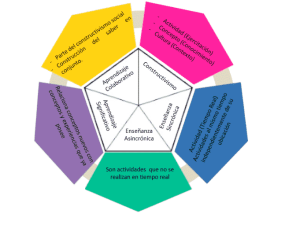
Figure No. 1. Pentateuchal Complex.
Note: Infographic of theories and concepts with their characteristics related to Distance Education.
The infographic takes into account that one of the characteristics of collaborative learning is its origin in social constructivism, and the other is the joint construction of knowledge. Furthermore, there are the characteristics of constructivism, from which three aspects emerge: activity (practice), concept (knowledge), and culture (context). In addition, meaningful learning is characterized by the relationship of new concepts with existing concepts and experiences. Synchronous teaching, which takes place in “real time,” cannot be overlooked, along with asynchronous teaching, which is not conducted in real time.
The theories of constructivism, collaborative learning, and meaningful learning are integrated into a complex approach. Constructivism focuses on the construction of individual knowledge, while collaborative learning emphasizes the joint creation of knowledge. Both require contextualized activities. Meaningful learning, for its part, relates new concepts to prior knowledge, which also refers to the context. These theories interrelate and are applied recursively in Distance Education, both synchronous and asynchronous, through digital tools, platforms, and social networks. Thus, a pentateuchal approach based on hologrammatic, dialogical, and recursive principles is configured, generating the following infographic:
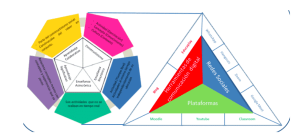
Figure No. 2. Distance Education Infographic in Light of the Socio-educational Reality.
Note: The infographic shows the integration of the pentateuchal complex with digital tools, social networks, and platforms for the development of Distance Education.
On the left side of the Distance Education Infographic, in light of the Socio-educational Reality, it can be seen how constructivism, collaborative learning, and meaningful learning have common ground such as knowledge, concept, or understanding, as explained earlier. Furthermore, there is also a relationship in terms of culture, context, or experience, and the activities or practice that are in turn related when delivering Distance Education synchronously (real-time) and asynchronously (any agreed-upon time) through digital communication tools, platforms, and social networks found on the right side of the infographic cannot be overlooked.
Digital Transition in Education: From Face-to-Face to Virtual
In several institutions around the world where Education was face-to-face or Blended, when social isolation began due to the COVID-19
pandemic, the full implementation of tools for the development of distance classes became necessary, which would be one hundred percent virtual from that moment on. Within these strategies, digital tools emerged according to the socio-educational reality being managed, and depending on the connectivity available to teachers and participants, processes were generally asynchronous and very rarely synchronous, as not everyone had permanent connectivity at home.
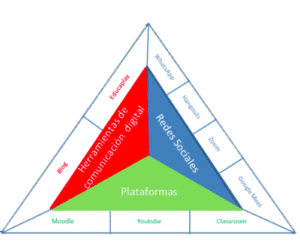
In light of this, the infographic shows the platforms that were mostly used, such as Moodle, Classroom, Google Meet, and YouTube, for the development of activities like materials, videos, assignments, tutorials, comments, and evaluations. In the case of YouTube, teachers created tutorials that they then uploaded to their channels so that participants could access them via Classroom, blog, or WhatsApp, in order to broaden communication channels between teachers and students.
Regarding social networks, one of the most used was WhatsApp, where the communication process flowed more easily since, through groups, the teacher could communicate information, conduct forum chats, and send videos or tutorials to help with the educational process. The advantage of this tool is that it is generally used asynchronously. On the other hand, social networks such as Hangouts, Zoom, and Google Meet were used to develop video conferences, presentations, and video forums.
Digital communication tools were also approached through Blogs, where links, videos, and comments were posted. Another tool was Educaplay, used by teachers to develop tests, maps, and games with self-assessment.
It is important to highlight that through interviews with teachers and students, they expressed that through digital communication tools, platforms, and social networks, knowledge could be acquired adequately, and they believe this will help change the face-to-face culture, meaning that both teachers and students will not be forced to incur travel expenses to institutions, and as UNESCO states, “It is necessary to leverage Information and Communication Technologies (ICT) to strengthen educational systems, the dissemination of co