
When referring to emotions, it is clear that they are a complex phenomenon of human development. It has been the subject of study by multiple disciplines such as: biology, anthropology, sociology, psychology, and evidently neurosciences. Therefore, this aspect is of great interest in different areas of knowledge, especially because emotions constitute an essential part of human behavior. This analysis, therefore, proposes a look from the neurosciences.
The Study of Emotions
Scientific approaches have provided an excellent precedent for the study of emotions, and their contributions, dating back to the second half of the 19th century, have undoubtedly paved the way for their understanding.
Theoretical Bases in the Study of Emotions
Charles Darwin (1899)
- Main Postulates
- Modular approach to emotions
- Attributes a universal meaning to emotions
- Considers their function to be the survival of the individual and the species
- Observational scientific method of facial and bodily expressions
- Approach
- Psychological
Wilhelm Wundt (1896)
- Main Postulates
- Dimensional approach to emotions
- Pleasure-displeasure (valence)
- Activation-relaxation (intensity)
- Relief-tension (control)
- Introspective-subjective study method, considering emotions as qualitative events.
- Dimensional approach to emotions
- Approach
- Psychological
William James (1890)
- Main Postulates
- Assumes Darwin’s modular approach to emotions.
- Indicates that each emotion has a pattern of appearance in the individual.
- Recognizes emotion as a quality of behavior, but with a neurophysiological approach.
- Defends physiological recording methodology as the most appropriate for advancing the knowledge of emotions.
- Approach
- Neuroscientific
Santiago Ramón y Cajal (1904)
- Main Postulates
- Considered the integration of intelligence and emotions in the organ of consciousness through the innate excellence of brain architecture.
- Made fundamental contributions to the notion of consciousness, considering it the darkest area in brain studies, indicating that it is located in the cortical cortex.
- States that the soul is located at the end of the cerebral cortex.
- Argues that emotions are very important for consciousness.
- Approach
- Neuroscientific
Source: Alleyne (2021), based on the approaches of the authors indicated in the table.
According to the aforementioned bases, initially in a first neuroscientific approach, James (1890) stated that emotional processes were the result of the cerebral cortex’s discernment of visceral and somatic changes generated in response to external situations interpreted as relevant for the individual’s survival.
Brain and Emotion Interaction: Agreements and Disagreements in their Explanation
Ramón y Cajal (1904) defined neurons as the invisible butterflies of the soul, which implied the integration of emotions into the concept of consciousness, considering them instances without an obvious design to be unveiled in the study of brain architecture.
For much of the 20th century, many neuroscientists attempted to explain the interaction between brain and emotion, including James and Cannon, who expressed their contrasting views on the matter.
An important point of agreement is that in both perspectives, the predominant role of the central nervous system in emotions is clear. Furthermore, these stances have allowed for the advancement and emergence of new theories to explain emotions from a neuroscientific perspective.
Diagram 1. James’s Theoretical Perspective on Emotion Production from the Brain
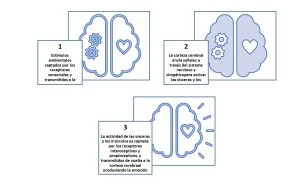
Source: Alleyne (2021) based on James’s (1890) approaches
For his part, Cannon (1931), another neuroscientist interested in the study of emotions, proposes that their neurological steps are as follows:
Diagram 2. Cannon’s Theoretical Perspective on Emotion Production from the Brain
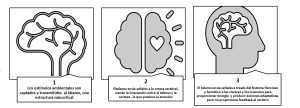
Source: Alleyne (2021) based on Cannon’s (1931) approaches
Neurophysiological Mechanisms of Emotions: A Contemporary View
According to Calixto (2018), the human brain is the organ that generates, interprets, and integrates emotions, as emotional processes are initiated, understood, categorized, memorized, and attended to within it. Thanks to neuropsychology, current advances in science and technology allow us to understand the neural and physiological circuit of emotions through neuroimaging and its analysis.
In this regard, Calixto (2018) agrees with the contributions of Ekman (2016), who deduced that there is a set of universal basic emotions for all human beings, founded on innate brain modules.
In this sense, for example: crying, anger, laughter, surprise, and even disgust are responses initiated in the limbic system, maintained in neural structures such as: basal ganglia, the hippocampus, and the cerebellum, to then be interpreted in the cingulate gyrus, and projected into higher neural regions of the brain where the prefrontal, parietal, and temporal cortices are involved.
From this point of view, emotions are psychophysiological reactions caused by the release of neurotransmitters and hormones. Evidently, these emotional processes, which are seated in the brain, are of great relevance for enhancing psychosocial development and building affectionate relationships.
Likewise, the knowledge of one’s own emotions generates the commitment to recognize them in others and to self-manage them, which will undoubtedly lead to better inter and intrapersonal interaction that will contribute to the individual’s socio-emotional well-being.
Figure 1. Neurophysiological network involved in some emotional processes
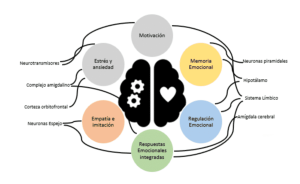
Source: Alleyne (2021) based on Calixto’s (2018) approaches
For his part, Alleyne (2017) highlights that one of the most astonishing characteristics of the brain is that it is an extraordinarily plastic organ, as it possesses the capacity to regenerate, adapt its activity, and significantly change its structure throughout life, a particularity that also nuances emotions, which can be adaptive according to the experiences lived by the person.
In this vein, it is considered that generating an adequate brain architecture, as proposed by Ramón y Cajal (1904), must stem from the construction of emotional processes managed on the scaffolding of positive thoughts and emotions, and, therefore, adopting an approach based on these principles can help avoid succumbing to negative emotions.
Closing Remarks
Undoubtedly, both memory and emotion regulation are linked to new experiences and learning, which contributes to a harmonious brain architecture.
Some keys to contributing to this architecture indicate that the relationship between the cognitive and the emotional must be considered; for this, the brain requires recursive coherence between discourse and action.
In this sense, it is essential to know that the brain can change based on experiences, and that emotions are decisive in this aspect, as they maintain curiosity, are necessary for communication, and are essential in reasoning and decision-making processes; that is, emotional and cognitive processes are inseparable. Furthermore, positive emotions favor the development of memory and learning.
Finally, in the human brain, nothing is idle; everything is used! Every neuron is continuously active and prepared, so whether through the simple act of hugging, giving thanks, laughing, or listening to music, oxytocin is released, amygdala activity is reduced, the immune system is helped, emotions are regulated, stress is reduced, and serotonin and dopamine production increases, which improves sleep and the quality of personal relationships.
Bibliographical References
Alleyne, D. (2017) Viaje al maravilloso mundo neuronal. Malla Didáctica de Ciencias. Agencia Universitaria para la Gestión del Conocimiento. Proyecto Auge. Digital. España y Ecuador.
Cannon, W (1931) Again the James-Lange and the thalamic theories of emotion. The Psychological Review 38,281-295
Calixto, E (2018) Emociones en el cerebro. Foro de Ciencias, Artes y Humanidades en Diálogo. Alambique N° 132. Fundación UNAM. México
Darwin, Ch. (1899). The Expression of the Emotions in Man and Animals. New York: D. Appleton and Company.
Ekman, P. (2016). What scientists who study emotions agree about. Perspectives on Psychological Science, 11, 31-34.
James, W. (1890). Principios de psicología [Principles of psychology]. México: Fondo de Cultura Económica, 1989.
Ramón y Cajal, S (1904) Textura del sistema nervioso del hombre y de los vertebrados. Madrid, Imprenta y Librería de Nicolás Moya.
Wundt, W (1896). Grundriss der psychologie. Engelmann, Stuttgart, Germany.