
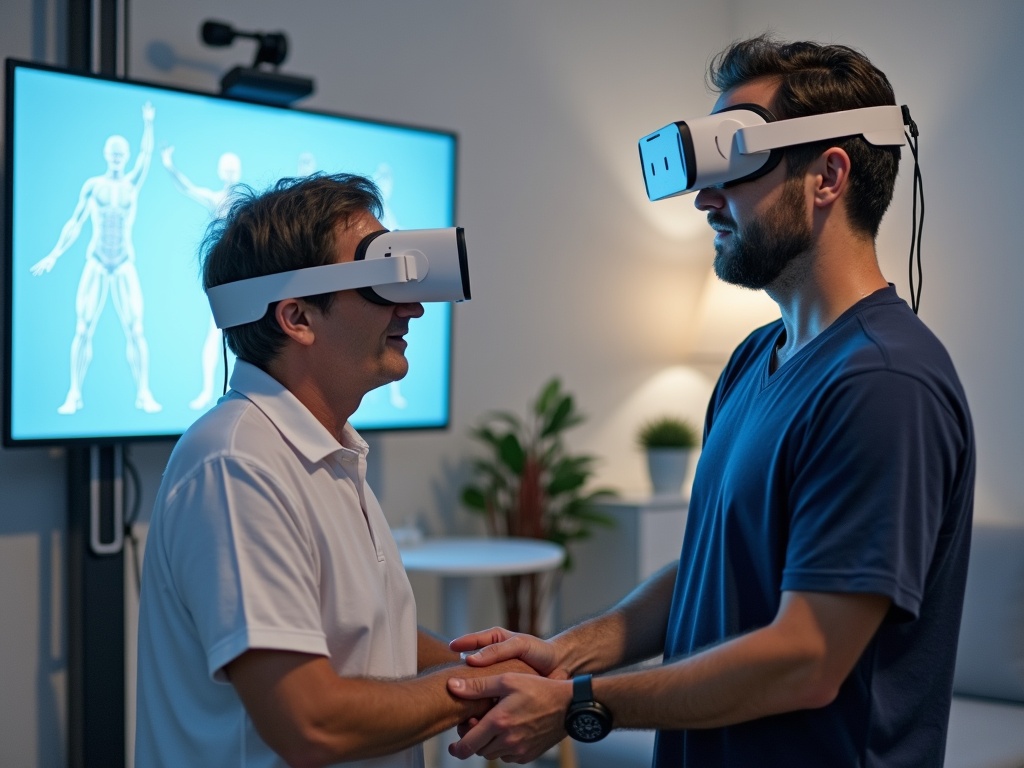
Virtual Reality in Language Therapy
Estimated reading time: 8 minutes
Key Takeaways
- Virtual Reality revolutionizes language therapy, offering simulated and personalized environments.
- The integration of VR in aphasia treatment can reduce therapeutic time by up to 40%.
- Studies and real cases support its effectiveness in rehabilitation and communication improvement.
- Innovation and the incorporation of artificial intelligence promise a more personalized future in therapies.
Table of Contents
Virtual Reality in language therapy is emerging as a revolution in the field of rehabilitation and education, transforming traditional strategies and offering new opportunities for the treatment of communication disorders, especially in patients suffering from aphasia. In a context where technology redefines our professional practices, prestigious institutions such as Universidad ISEP have decisively committed to integrating Virtual Reality (VR) into language-oriented therapies. This article aims to analyze in detail the effectiveness of VR in the treatment of aphasia, demonstrating its potential to reduce rehabilitation times by up to 40%, through an innovative, interactive, and personalized approach.
The following sections will address fundamental aspects such as the definition of VR in language therapy, its specific applications in aphasia rehabilitation, the evidence and benefits supported by clinical studies, as well as innovative and future perspectives in this field. You will discover how VR enhances interactive and dynamic exercises that not only modernize the therapeutic process but also reaffirm the commitment of institutions like Universidad ISEP to lead the transformation of language treatment.
Contextualization of Virtual Reality in Language Therapy
Virtual Reality is defined as an immersive technology capable of generating interactive digital environments that simulate controlled and realistic scenarios. This characteristic positions it as a valuable tool in language rehabilitation, allowing the recreation of everyday situations relevant to the patient. The application of VR is based on the use of advanced devices, such as virtual reality headsets and motion controllers, combined with specialized software. To delve deeper into these methodologies, learn about the Master’s in Language Therapy.
Subheadings and bullet points for better understanding:
• Interactive and simulated environments:
– VR recreates daily life scenarios where the user can practice tasks such as shopping, conversing, or facing social situations.
– It allows therapists to design specific and personalized exercises.
• Innovation in language rehabilitation:
– Integrates digital technology to foster patient motivation and engagement.
– Creates playful exercises that optimize the recovery process.
• Technology in language therapy:
– Advanced devices and software generate a multisensory experience.
– Promotes interactive and adaptive learning, overcoming limitations of conventional techniques.
Studies and references, such as those from IBEC Barcelona and ICS Camp de Tarragona, have shown that the integration of VR in rehabilitation creates motivating scenarios ideal for both individual and pair work.
Specific Applications in Aphasia Treatment
Aphasia, a disorder affecting the ability to understand and produce language, has traditionally been treated with conventional methods. The incorporation of Virtual Reality offers innovative strategies to strengthen different aspects of language.
Applied methods include:
• Vocabulary and recognition exercises:
– Interaction with virtual objects: Patients manipulate and associate images, words, and sounds in a digital environment.
– Association games: Dynamics that relate words to images or actions. To learn more about innovative programs, visit the Master’s in Innovation in Health.
• Stimulation of syntax and sentence construction:
– Interactive tasks that progressively build complex sentences.
– Simulated conversation scenarios to practice responses.
• Integration of oral and gestural motor skills:
– Exercises that combine movements and speech to improve verbal articulation.
– Simulations of daily tasks that reinforce the functional aspect of language.
A study published by InnovaSpain showed significant improvements in patients with Broca’s aphasia after intensive VR sessions. Similar results have been reported by ICS Camp de Tarragona.
Evidence and Benefits of Virtual Reality
VR in language therapy has growing scientific support and clinical testimonials confirming its multiple benefits:
• Effectiveness in clinical practice:
– Clinical trials demonstrate notable improvements in standardized language tests, facilitating accelerated recovery. Discover more in the Master’s in Neurosciences.
– Immersive environments that foster self-confidence and active participation.
• Reduction of therapeutic time:
– VR has been shown to shorten the time needed to achieve significant progress by up to 40%.
– Optimizes resources and improves patients’ quality of life.
• Increase in motivation and adherence:
– The playful nature of the technology transforms rehabilitation into an interactive and motivating experience.
• Sustained results:
– The possibility of re-evaluating exercises in virtual environments consolidates medium-term benefits.
Case studies and references, such as those from IBEC Barcelona and ICS Camp de Tarragona, support these findings, showing that VR reactivates language circuits comprehensively.
Innovation and Future
The future of language rehabilitation with VR is promising, marked by technological advancements and interdisciplinary collaboration:
• Simplification and portability:
– More compact and user-friendly devices will be developed, enabling treatments in home environments.
• Artificial intelligence and personalization:
– The integration of AI will allow exercises to be adapted in real-time according to each patient’s progress.
• Patient-centered approach:
– The creation of interactive programs empowers the user, integrating emotional and cognitive aspects for comprehensive treatment.
• Interdisciplinary collaboration:
– Institutions like Universidad ISEP promote projects that merge engineering, neurology, psychology, and language therapies, raising rehabilitation standards.
To learn more about advanced training in emerging technologies, explore the Master’s in Digital Technologies.
Conclusion
The integration of Virtual Reality in language therapy radically transforms the treatment of aphasia. By combining immersive digital environments, interactive exercises, and personalized support, rehabilitation is accelerated, and communication is optimized.
In summary, VR:
• Redefines therapy by recreating real contexts that motivate active practice.
• Enhances vocabulary exercises, syntactic stimulation, and motor coordination in aphasia treatment.
• Demonstrates, through studies and empirical evidence, a significant reduction in therapeutic time.
• Opens a future of more personalized treatments thanks to technological innovations and interdisciplinary collaboration.
Institutions like Universidad ISEP have been pioneers in the application of this technology, demonstrating that the union between innovation and evidence is key to transforming treatments.
Virtual Reality does not replace traditional techniques but complements them, offering an alternative that increases the efficiency and motivation of the therapeutic process. The path towards more effective and humane language rehabilitation has already begun.
Frequently Asked Questions
-
What is Virtual Reality in language therapy?
Answer: It is the use of immersive technology to create interactive environments that facilitate the rehabilitation and improvement of communication in patients with language disorders. -
How does VR improve aphasia treatment?
Answer: VR allows for the design of personalized exercises that stimulate vocabulary, syntax, and oral motor skills, reducing recovery time by up to 40%. -
What are the future prospects of VR in rehabilitation?
Answer: More portable devices, integration of artificial intelligence to personalize treatments, and an increasing focus on the patient-centered experience are expected.
Solicitar más información
Completa el formulario y un asesor te contactará en menos de 24 horas hábiles.
Los campos obligatorios están marcados *